

What is Retrieval-Augmented Generation (RAG)?
Retrieval-Augmented Generation (RAG) is one of the most advanced AI techniques that combines the power of Large Language Models (LLMs) with real-time information retrieval. Instead of relying only on what the AI learned during training, RAG retrieves relevant information from external knowledge sources before generating a response.
This makes AI applications more accurate, up-to-date, reliable, and context-aware.
Today, companies like Microsoft, Google, OpenAI, Meta, and Amazon are using RAG-based systems to build intelligent chatbots, enterprise search engines, customer support assistants, and knowledge management platforms.
Why Do We Need RAG?
Traditional AI models have limitations:
- Knowledge becomes outdated after training.
- They may generate incorrect or “hallucinated” answers.
- They cannot access private company documents without additional systems.
- Retraining large AI models is expensive and time-consuming.
RAG solves these problems by allowing AI to retrieve relevant information from external databases before generating an answer.
How Does RAG Work?
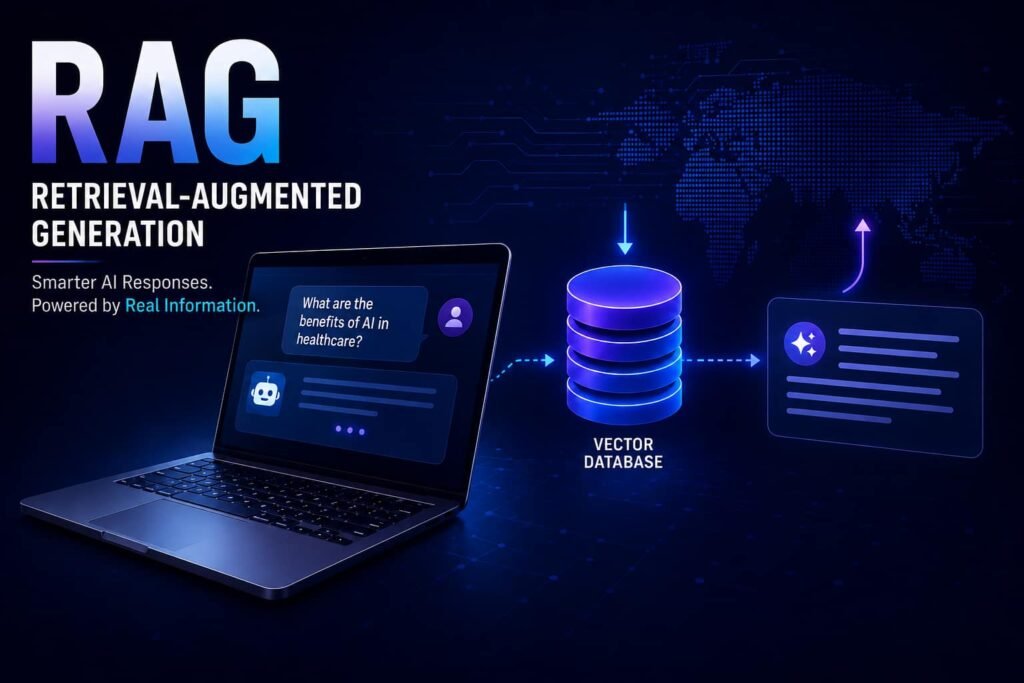
A typical RAG workflow follows these steps:
Step 1: User Query
A user asks a question.
Example:
“What are the latest AI trends in healthcare?”
Step 2: Query Embedding
The question is converted into a numerical vector (embedding).
Step 3: Retrieve Relevant Documents
The system searches a vector database and retrieves the most relevant documents.
Step 4: Context Injection
The retrieved information is combined with the user’s question.
Step 5: AI Response Generation
The Large Language Model generates an accurate answer using the retrieved context.
This process significantly improves the quality and factual accuracy of AI responses.
RAG Architecture
A standard Retrieval-Augmented Generation architecture consists of:
- User Interface
- Embedding Model
- Vector Database
- Retriever
- Large Language Model (LLM)
- Response Generator
The retriever fetches the most relevant information, while the LLM generates a natural-language response based on that information.
Components of a RAG System
1. Large Language Model (LLM)
Popular LLMs include:
- GPT-4.1 / GPT-5 family
- Llama
- Claude
- Gemini
- Mistral
These models generate human-like responses.
2. Embedding Model
Embedding models convert text into vectors that capture semantic meaning.
Popular options include:
- OpenAI Embeddings
- Sentence Transformers
- BAAI BGE
- E5 Models
3. Vector Database
A vector database stores embeddings for fast semantic search.
Popular vector databases:
- Pinecone
- Weaviate
- Chroma
- Milvus
- Qdrant
- FAISS
4. Retriever
The retriever finds the most relevant documents based on semantic similarity.
Common retrieval methods include:
- Dense Retrieval
- Hybrid Search
- Semantic Search
- BM25 + Vector Search
5. Prompt Builder
The retrieved information is inserted into the prompt before sending it to the LLM.
This ensures responses are grounded in reliable information.