


What is Cyber Security?
Cyber Security is the practice of protecting computers, networks, applications, cloud systems, and data from cyber threats such as:
- Malware
- Ransomware
- Phishing
- Data breaches
- Identity theft
- Hacking
- Insider threats
- Denial-of-Service (DoS/DDoS) attacks
Why is Cyber Security Important?
Cyber Security is crucial because it helps:
- Protect personal and business data
- Prevent financial losses
- Secure online banking and digital payments
- Protect customer privacy
- Ensure business continuity
- Reduce cybercrime risks
- Build customer trust
- Meet regulatory and compliance requirements
Types of Cyber Security
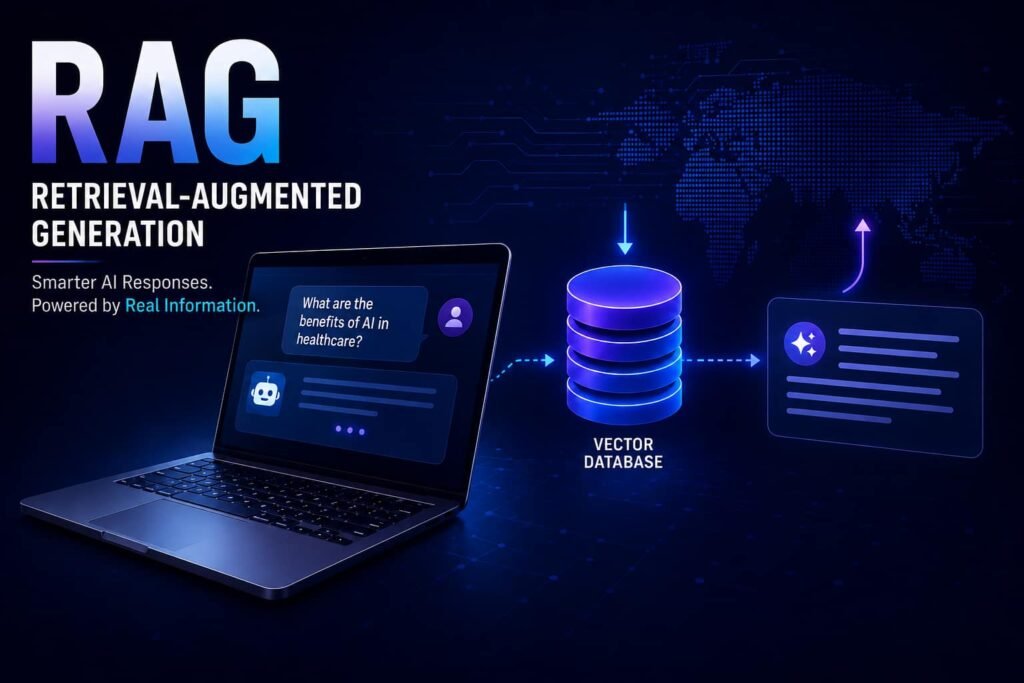
A typical workflow follows these steps:
Step 1: User Query
A user asks a question.
Example:
“What are the latest AI trends in healthcare?”
Step 2: Query Embedding
The question is converted into a numerical vector (embedding).
Step 3: Retrieve Relevant Documents
The system searches a vector database and retrieves the most relevant documents.
Step 4: Context Injection
The retrieved information is combined with the user’s question.
Step 5: AI Response Generation
The Large Language Model generates an accurate answer using the retrieved context.
This process significantly improves the quality and factual accuracy of AI responses.
Common Cyber Threats in 2026
A standard Retrieval-Augmented Generation architecture consists of:
- User Interface
- Embedding Model
- Vector Database
- Retriever
- Large Language Model (LLM)
- Response Generator
The retriever fetches the most relevant information, while the LLM generates a natural-language response based on that information.
Role of AI in Cyber Security
Artificial Intelligence is transforming cybersecurity by helping organizations:
- Detect threats in real time
- Analyze large volumes of security data
- Automate incident response
- Identify unusual user behavior
- Prevent fraud
- Reduce false positives
- Predict emerging attack patterns
AI-powered security tools improve the speed and accuracy of detecting and responding to cyber threats.
Cyber Security Best Practices
Protect yourself and your organization by following these practices:
- Use strong, unique passwords
- Enable Multi-Factor Authentication (MFA)
- Keep software updated
- Back up important data regularly
- Avoid clicking suspicious links
- Use antivirus and endpoint protection
- Secure Wi-Fi networks
- Encrypt sensitive data
- Train employees on cybersecurity awareness
- Monitor systems continuously