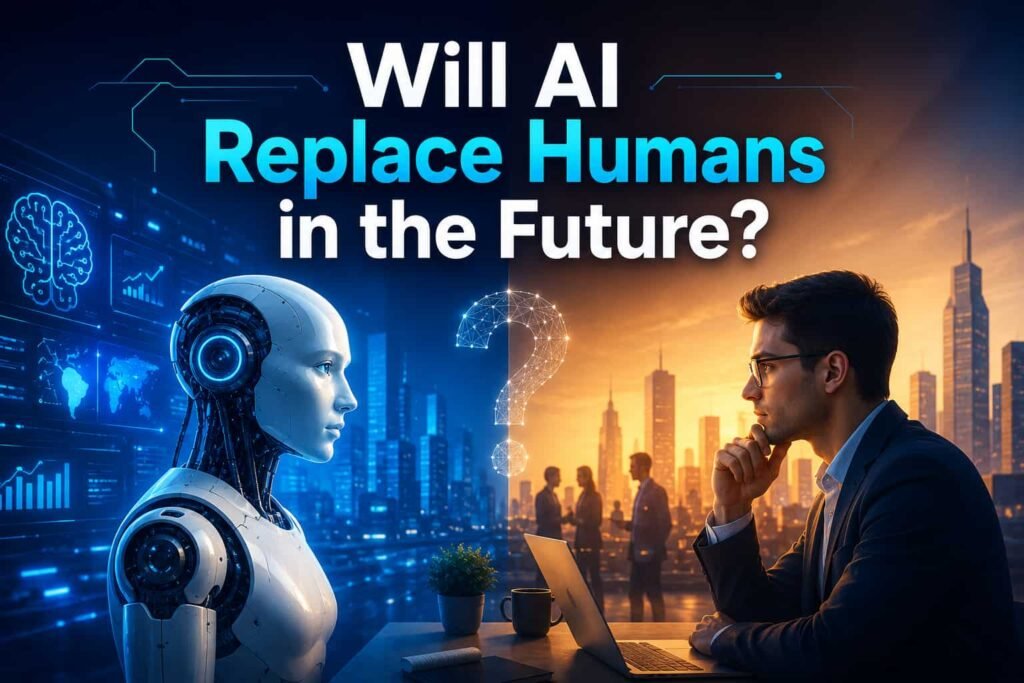


Will AI Replace Humans in the Future?
Artificial Intelligence (AI) has transformed industries across the world. From AI-powered chatbots and virtual assistants to autonomous vehicles and advanced data analysis, AI is becoming a part of everyday life. This rapid growth has sparked an important question:
Will AI replace humans in the future?
The simple answer is No—not entirely. While AI will automate many repetitive tasks and change how people work, it is far more likely to transform jobs rather than eliminate humans. The future belongs to people who know how to work alongside AI.
What Makes AI So Powerful?
AI can perform tasks such as:
- Analyzing massive amounts of data
- Recognizing images and speech
- Writing content
- Translating languages
- Detecting patterns
- Automating repetitive processes
- Assisting with coding and customer support
These capabilities make businesses more productive and efficient.
What AI Can Do Better Than Humans
AI excels at:
- Processing data quickly
- Working 24/7 without fatigue
- Automating repetitive tasks
- Detecting patterns in large datasets
- Reducing human error
- Performing routine calculations
This is why AI is widely used in industries like healthcare, banking, manufacturing, retail, and logistics.
Jobs That Will Continue to Grow
Demand is increasing for professionals in:
- Artificial Intelligence
- Machine Learning
- Cyber Security
- Data Science
- Cloud Computing
- Software Development
- Digital Marketing
- UI/UX Design
- Healthcare
- Robotics Engineering
These fields combine technical expertise with human judgment and creativity.
AI Creates New Career Opportunities
As AI adoption grows, new job roles are emerging, including:
- AI Engineer
- Machine Learning Engineer
- Prompt Engineer
- AI Product Manager
- AI Consultant
- Data Scientist
- AI Trainer
- Robotics Engineer
- AI Ethics Specialist
- Automation Engineer
Learning AI-related skills can open doors to exciting and high-demand careers.
AI and Humans: Better Together
The future is not AI vs Humans—it is AI + Humans.
For example:
- Doctors use AI to analyze medical images faster.
- Teachers use AI to personalize learning.
- Designers use AI to generate creative ideas.
- Software developers use AI to write and review code.
- Digital marketers use AI to optimize campaigns.
In each case, AI acts as a powerful assistant while humans make the final decisions.