

Degree vs skill 2026 is one of the most debated topics among students and professionals today. As industries rapidly evolve with AI, automation, and digital transformation, many people are confused about whether a degree or practical skills matter more for career success.
Let’s be honest—we’ve all heard the same line since the 10th standard: “Bas degree le lo, life set ho jayegi.” But as we navigate 2026, that “Life Set” promise feels like a bad investment for most of us. I’ve personally seen M.Tech grads from decent colleges struggling to clear basic interviews for ₹3.5 LPA packages, while 19-year-olds from Tier-3 cities are pulling ₹15 Lakh remote jobs. The “Golden Ticket” is officially out of print. The world doesn’t care about your college tier as much as it cares about your terminal window or your design portfolio.
The old narrative is crumbling. We aren’t just in an “Information Age” anymore; we are in the “Results Age.” It’s no longer about what you know—Google and AI already know everything. It’s about what you can do with what you know.
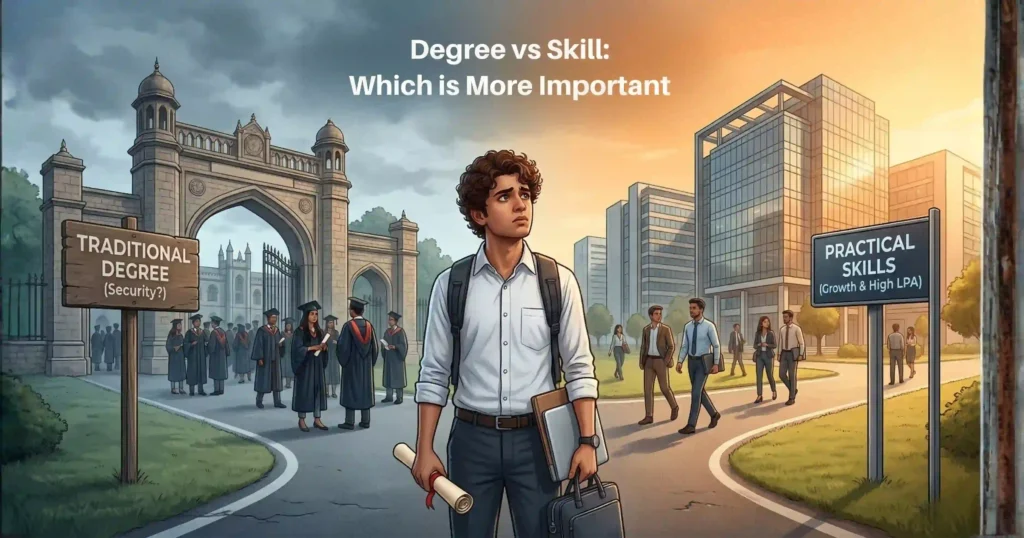
If you’re standing at a crossroads, wondering if you should grind through four years of a boring university syllabus or drop out to join a “hustle,” this is the honest, unfiltered truth about the Degree vs Skill debate in the Indian context.
Degree Vs Skills The "Quick Answer" for the Impatient
What is more important in 2026: a degree or a skill?
In the 2026 Indian job market, in comparison of degree vs skills, skills are 10x more important for high-growth sectors like Tech, Product Design, and Digital Marketing. However, a degree remains a non-negotiable “legal filter” for regulated professions like Medicine, Law, and Civil Engineering. For the average Indian professional, the most successful path is a “Hybrid Model”—using a degree for social credibility and networking, while building high-income skills for actual career growth.
The Great Hiring Shift: Why the Rules of the Game Broke
For decades, Indian HR departments used degrees as a filter. It was an easy way to narrow down 10,000 applicants to 50. But in the last couple of years, even the big service-based giants (think TCS, Infosys, Wipro) realized that a B.Tech degree doesn’t always equal competence.
Why your 2022 Syllabus is “Kachra” (Trash) in 2026
While Talking on Degree vs Skill, the biggest enemy of traditional Indian education is speed. An Indian university syllabus moves at the speed of a government file—it takes years to change a single line.
Why Tech Moves Faster than Textbooks
If you’re studying a textbook printed in 2022, you’re missing out on the entire Generative AI revolution that redefined SEO, coding, and design in 2024 and 2025. You’re learning how to “print Hello World” while the industry is already using AI Agents to build entire apps in minutes. Tech doesn’t wait for tenure-track professors to update their PPTs.
The Rise of “Proof of Work”
Recruiters are tired of “promises.” A degree is a promise that you might know something. A portfolio is proof that you do.
Case Study: The 2025 “Off-Campus” Explosion
In 2025, we saw a massive surge in “Off-Campus” hiring. Why? Because students realized that the “Placement Cell” was only bringing in low-paying mass recruiters. The smart kids started building “Proof of Work” on LinkedIn and Twitter, bypassing the placement cell entirely to land high-paying roles in startups based in Bangalore, Gurgaon, or even Silicon Valley (working remotely).
Why Skills are Winning the Race of Degree vs Skills Right Now
In Degree Vs Skill, skills are the “currency” of 2026. You can trade them for money instantly. A degree is more like a “long-term fixed deposit”—it might pay off later, but you can’t use it to pay your bills today.
Portfolios over Marksheets
In 2026, your “Marksheet” is basically a decorative item. A recruiter would rather see a live website you built, a marketing campaign you ran for a local brand, or a Figma file of a real-world app.
GitHub for Developers
If you’re a coder, your GitHub is your resume. A hiring manager can see exactly how you solve problems, how clean your code is, and how you collaborate with others. No university transcript can provide that level of detail.
Behance and LinkedIn for Creatives
Graphic designers and video editors are no longer asked which art school they attended. They are asked to share a link to their latest project. If your work is professional, nobody cares if you learned it at a top-tier college or through a ₹2,000 course on Udemy.
The ROI Factor: The Math of Lakhs
Think about the ROI. You spend ₹10 Lakhs to ₹20 Lakhs on a private engineering college or a B-School. If you end up with a 4 LPA job, it’ll take you years just to break even. On the flip side, you can spend ₹5,000 to ₹50,000 on specialized bootcamps or even learn for free. If that skill lands you a 12 LPA job, you’ve won the game before it even started.
The “Hidden” Value of a Degree (Where the Paper Still Wins)
After degree vs skills comparison, I’m not here to tell you to burn your books. A degree isn’t just about the subjects you study; it’s about things that are hard to replicate on YouTube.
The Power of Social Capital and Networking
College is the ultimate networking hub. The people you meet in your hostel or during cultural fests are the people who will refer you for jobs ten years later. You can learn Python online, but you can’t “download” the experience of collaborating with a diverse group of peers.
Discipline and the “Finish Line” Effect
Completing a degree proves you can stick to something for four years. It shows a recruiter that you can handle deadlines, deal with difficult professors, and navigate a complex system. It’s a test of stamina more than a test of intelligence.
Regulated Industries: The Non-Negotiables
Let’s be real—nobody wants a “self-taught” surgeon or a pilot who learned from a “6-week bootcamp.”
- Medicine: You need the rigorous, supervised training that only a medical degree provides. There is no shortcut here.
- Law: In India, you cannot stand in court without an LLB degree. It’s a legal requirement.
- Civil Engineering: When you’re building bridges or skyscrapers, “learning on the fly” isn’t an option. You need the deep theoretical foundation.
Degree vs Skill: A Side-by-Side Reality Check (2026)
Degree vs skills
Feature | University Degree | Practical Skills |
Primary Goal | Foundation & Social Status | Immediate Job Performance |
Time Investment | 3 to 5 Years | 3 to 12 Months |
Financial Cost | High (₹10L – ₹25L) | Low (₹0 – ₹1L) |
Market Stability | High (Long-term credibility) | Moderate (Needs constant updates) |
Networking | High (Alumni & Professors) | Moderate (Online communities) |
Best For | Doctors, Lawyers, Govt Jobs | IT, Creative, Sales, AI |
The “Hybrid Professional” Strategy (The 70/30 Rule)
If I were 18 today, I wouldn’t choose one or the other. I’d play both sides. I call it the 70/30 Hybrid Model.
Don’t quit college just because some “Influencer” told you degrees are dead. But at the same time, don’t think that passing your exams is enough to survive.
How to Build Skills While Earning a Degree
- 30% Focus (The Degree): Spend just enough energy to get the degree. Maintain a decent percentage so you don’t get filtered out by old-school HR bots.
- 70% Focus (The Skill): While you’re in college, start a side project. Write on a blog, build an app, or manage social media for a local business.
By the time you graduate, you have the “Safety” of the degree and the “Speed” of the skill. That is how you become recession-proof.
Final Thought: Stop Asking “Which is Better?”
From this blog ‘Degree vs Skill’, degrees tell people what you could do. Skills show people what you can do.
In 2026, the Indian market has no more patience for “could.” We are in a high-speed, high-stakes economy. If you’re relying on your degree to save you, you’re already behind. If you’re relying on just one skill, you’re vulnerable.
My final advice? If you are a student right now, build a Portfolio today. Stop waiting for the “Placement Season.” The moment you think you “know it all” because of your degree is the moment you become obsolete.
The market doesn’t care about your grades; it cares about what you can build, fix, or sell.
What do you think? Did your college degree actually help you, or was it just a ₹15 Lakh piece of paper? Drop a comment below—I actually want to know your story.
Frequently Asked Questions (Degree Vs Skills)
1. Can I really get a ₹10 LPA+ job without a degree in India?
Yes, but here is the catch: you have to be twice as good as a degree holder. You need an “undeniable” portfolio. In fields like UI/UX design, Full-stack development, and Digital Marketing, your work speaks louder than your college name.
2. Is an MBA a waste of money now?
Mostly, yes—unless it’s from an IIM or a Top-10 B-school. If you’re doing an MBA from a “Tier-3” college just for the degree, you’re better off spending that time and money on a specialized sales or product management certification and getting real-world experience.
3. Which skill is “AI-Proof” in 2026?
Anything involving “Complex Human Empathy.” AI can write code, it can design logos, and it can analyze data. But it cannot negotiate a difficult client contract, it cannot manage a team’s emotions during a crisis, and it cannot understand the “gut feeling” of a brand. Soft skills are the new hard skills.