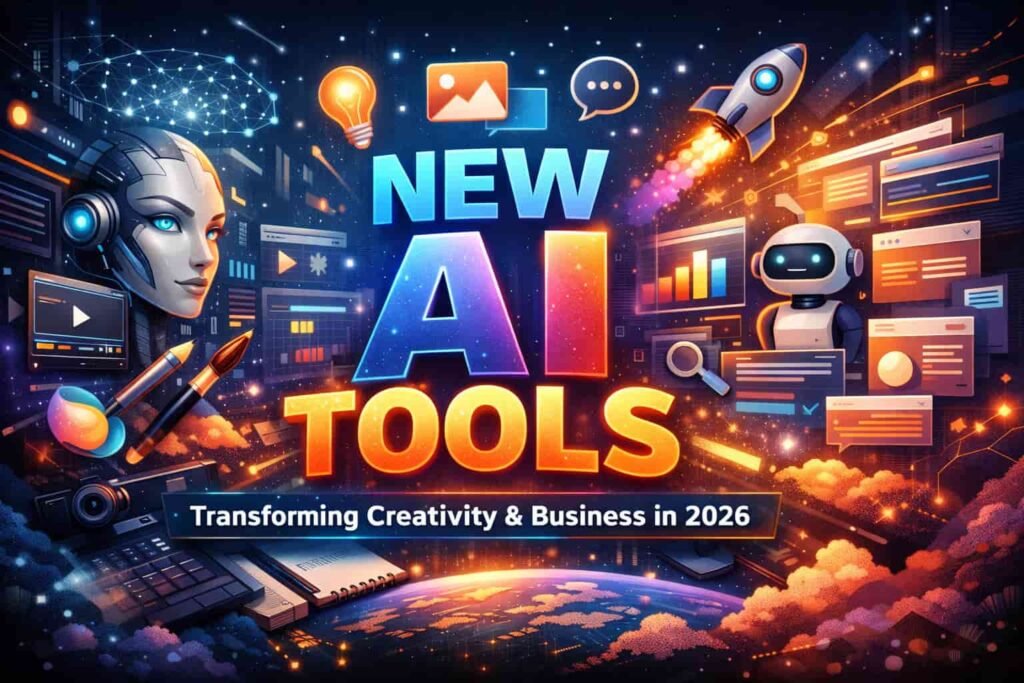


Artificial Intelligence (AI) has moved beyond being a futuristic concept—it is now the backbone of modern creativity, marketing, and business growth. In 2026, a wave of new AI tools is reshaping how professionals design, communicate, and innovate. Whether you are a branding strategist, a web developer, or a digital marketer, these tools offer efficiency, personalization, and scalability like never before.
Why AI Tools Matter Today
Speed & Efficiency: Automate repetitive tasks such as caption writing, image resizing, or SEO audits.
Creativity Boost: Generate fresh ideas, visuals, and copy that align with brand identity.
Scalability: Produce hundreds of assets—ads, posts, or videos—without sacrificing quality.
Data‑Driven Insights: Predict engagement, optimize campaigns, and personalize customer experiences.
AI tools are no longer optional—they are essential for staying competitive in digital industries.
AI Tools for Graphic Design
Adobe Firefly (with Photoshop Integration)
Generates professional‑grade images, textures, and design elements.
Perfect for branding assets, mockups, and creative campaigns.
Canva Magic Studio
Quick social media graphics, testimonial grids, and promotional scripts.
Ideal for small businesses and fast‑paced marketing teams.
Midjourney & DALL·E 3
Advanced generative art platforms for unique visuals.
Used for concept art, ad creatives, and storytelling visuals.
Leonardo AI & Recraft
Specialized in stylized illustrations and vector graphics.
Great for logos, icons, and creative branding projects.
AI Tools for Copywriting & Captions
Jasper AI – Long‑form content aligned with brand tone.
Copy.ai – Punchy captions and product descriptions.
Anyword – Predictive analytics to test engagement before publishing.
Lately.ai – Repurposes blogs or videos into multiple short captions.
These tools ensure your brand voice remains consistent while saving hours of manual writing.
AI Tools for Marketing & SEO
Surfer SEO – AI‑powered keyword optimization for blogs and landing pages.
MarketMuse – Content strategy and topic clustering.
HubSpot AI Assistant – Automates CRM tasks, email campaigns, and customer follow‑ups.
Google Gemini AI – Smart insights for ad targeting and campaign optimization.
With these, businesses can rank higher, attract more leads, and convert faster.
AI Tools for Video & Motion Graphics
Runway Gen‑2 – Text‑to‑video generation for ads and explainer clips.
Pictory AI – Converts long videos into short, shareable reels.
Synthesia – AI avatars for training modules and corporate presentations.
Camtasia + AI Plugins – Streamlined editing workflows for tutorials and demos.
Video content is king in 2026, and these tools make production accessible to all.
AI Tools for Business Automation
Microsoft Copilot – Integrated into Office and Windows for productivity.
Zapier AI Actions – Automates workflows across apps.
Notion AI – Smart note‑taking, project management, and team collaboration.
ChatGPT & Claude – Conversational AI for client communication and brainstorming.
Automation frees up creative professionals to focus on strategy and innovation.
AI Tools for Web Development
Durable AI Website Builder – Creates websites in minutes with AI‑generated copy and design.
Elementor AI (WordPress) – Smart suggestions for layouts, headlines, and visuals.
Hostinger AI Assistant – Simplifies hosting, SEO, and content creation.
GitHub Copilot – Assists developers with coding, debugging, and documentation.
These tools reduce technical barriers, enabling faster launches and smoother updates.
How Businesses Can Use New AI Tools
Branding Agencies: Generate logos, testimonials, and ad creatives at scale.
Training Institutes: Build interactive modules with AI avatars and captions.
Small Businesses: Automate social media, SEO, and customer communication.
Enterprises: Integrate AI into CRM, analytics, and workflow automation.
AI tools are versatile—they adapt to industries ranging from education to e‑commerce.
Challenges & Considerations
While AI tools are powerful, businesses must address:
Authenticity: Avoid generic outputs by customizing AI suggestions.
Ethics: Ensure transparency in AI‑generated content.
Data Security: Protect sensitive information when using cloud‑based AI.
Human Touch: Balance automation with creativity and emotional intelligence.
The Future of AI Tools
Looking ahead, AI will:
Merge multimodal capabilities (text, image, video, audio).
Offer hyper‑personalization for customer experiences.
Enable real‑time collaboration across global teams.
Drive innovation in education, healthcare, and entertainment.
AI is not replacing humans—it is empowering them to achieve more.
Conclusion
The rise of new AI tools in 2026 marks a turning point in digital creativity and business growth. From design and copywriting to automation and web development, these tools are redefining workflows and possibilities. For professionals and businesses, adopting AI is no longer about experimentation—it is about survival and success.
By embracing these innovations, you position yourself at the forefront of a rapidly evolving digital landscape. The future belongs to those who harness AI not just as a tool, but as a creative partner.